
How to write a day-by-day tour itinerary guests actually read
By Zakhar Habib · 23 November 2026

A tour itinerary guests actually read gives each day a clear title, a one-line summary, a rough timeline with the meeting time and place, where they are sleeping, which meals are included and what to bring, in that order, with short sentences and nothing they do not need. Write it for a guest glancing at a phone at breakfast, not for a brochure, and most of the questions you answer by email before and during a tour will answer themselves.
What a good tour itinerary is for
An itinerary does two jobs. Before the trip, it confirms what the guest has bought and helps them pack, plan flights and tell family where they will be. During the trip, it is the page they open each morning to check what time to be ready and whether lunch is included.
Both jobs reward the same thing: information that is easy to find. Guests rarely read an itinerary from top to bottom. They scan for today, then for the time, then for the one detail they need. A beautifully written paragraph that hides the pick-up time in its third sentence fails at the job, however good it sounds.
The structure that works for each day
Use the same layout for every day, so guests learn where to look. A reliable order is:
1. A day title that says where
"Day 3: Fort William to Skye" is more useful than "Day 3: Into the Mist". Put the start and end points, or the main place, in the title. Guests use the titles as a contents list.
2. A one-line summary
One sentence on what the day is about and how it feels: a long scenic drive, a slower day on foot, or a free afternoon. This sets expectations for energy and pace.
3. A rough timeline
List the stops in order with approximate times. Be precise about the things guests must act on, such as the departure time and meeting point, and relaxed about the rest. "About" and "late morning" are honest; a timetable to the minute sets you up to look late.
4. Accommodation
Name, address, check-in time, the number of nights and the board basis. Guests forward this to family more than any other part of the itinerary.
5. Meals
Say plainly which meals are included and which are not. "Lunch at your own expense; there is a café at the visitor centre" prevents more confusion than any amount of description.
6. What to bring or wear
Only when the day needs something unusual: walking boots, a waterproof, or cash for a small ferry or a car park that does not take cards. If every day says "bring a jacket", guests stop reading the line.
7. A guide tip or recommendation
One local tip per day is plenty: the best spot for a photograph, a quieter path, a restaurant worth booking for a free evening. This is where your knowledge shows, and it is what makes the itinerary feel like yours.
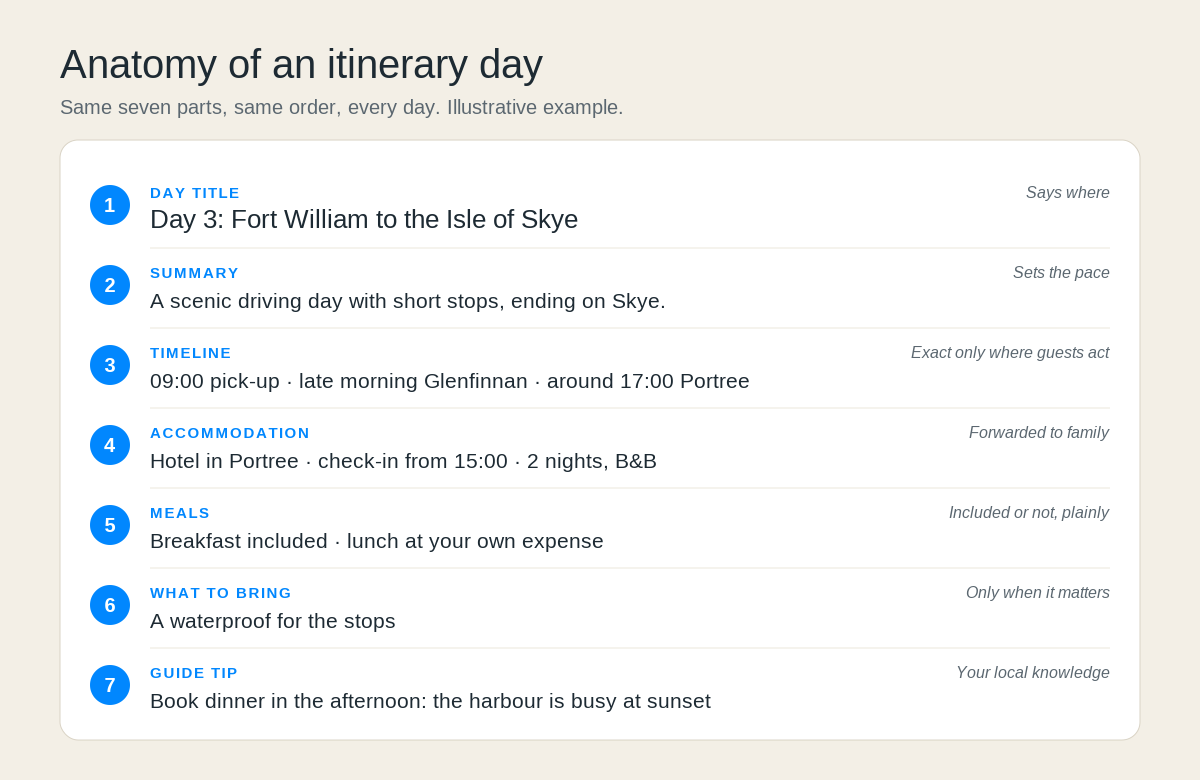
An example day, written for skimming
Here is an illustrative day from a private Highlands tour. The times and places are examples only; use your own route and suppliers.
Day 3: Fort William to the Isle of Skye
A scenic driving day with short stops, ending on Skye.
- 09:00 Pick-up at your hotel entrance. Bags in the vehicle, please.
- Late morning Short stop at Glenfinnan for the viaduct and monument.
- Lunch Not included. We stop in a village with a café and a deli.
- Afternoon Drive on to Skye with photo stops along the way.
- Around 17:00 Arrive at your hotel in Portree. Check-in from 15:00; two nights, bed and breakfast.
- Bring A waterproof for the stops; the weather turns quickly.
- Guide tip Portree harbour is busiest at sunset. Book dinner in the afternoon if you can.
Notice what is missing: no paragraphs of history, no adjectives in every line, nothing about the vehicle or the supplier bookings. Each line answers a question a guest would otherwise send you.
How to write each line
- Lead with the fact. Time, place or decision first, colour second.
- Keep sentences short. Some guests are reading in a second language, and everyone is reading on a small screen.
- Use the names guests will see. Match the hotel name on the booking confirmation and the place names on road signs.
- Be honest about the day. If a day involves a lot of driving, say so. Guests forgive long days they expected; they complain about ones they did not.
- Save description for the places that deserve it. Two or three sentences on the highlight of the day is enough. Link out to the website for anyone who wants more.
What to leave out
An itinerary is not the place for supplier reference numbers, your costings, driver instructions or internal notes. Those belong on the guide or driver sheet, which is built for your team rather than your guests. Keep booking terms and payment schedules in the documents that cover them, and link to them once rather than repeating them every day.
Common mistakes
- A different layout every day. Guests have to hunt for the time again each morning.
- Brochure copy instead of instructions. The itinerary is read after the guest has bought; it does not need to sell.
- Exact times you cannot keep. Be exact about pick-ups; use "about" for the rest.
- Out-of-date versions. A PDF sent in March and changed in May leaves the guest holding the wrong plan. Send one link that always shows the current version.
- Rewriting the same places from scratch. If you visit Glenfinnan on most tours, write that description once and reuse it.
Where TravelSpurt fits
In TravelSpurt, the itinerary is built from the booking and your activity library. The AI only uses activities from your library, so the descriptions, guide tips and photos are your own, and it never adds places you do not visit. You can then edit every day: add hotels with check-in time, nights and basis, add notes, mark restaurants or optional extras as client recommendations, and reorder items. When it is ready, you send the client one branded web link; they do not need an account to open it. The itineraries guide walks through each step.
Frequently asked questions
How long should a tour itinerary be?
As long as the trip needs and no longer. For each day, aim for a title, a one-line summary and a short list of timed items, with two or three sentences on the main highlight; guests should be able to find the day's key details in a few seconds.
Should a tour itinerary include exact times?
Give exact times only for things guests must act on, such as pick-ups, ferries and timed entries. For everything else, approximate times like "late morning" or "around 17:00" are more honest and leave room for weather and traffic.
Is a PDF or a web link better for sending an itinerary?
A web link is easier to keep up to date, because guests always see the current version and can open it on a phone. If you send PDFs, resend the whole document whenever anything changes and make the version date clear.
See how it works or pricing, or get in touch.