
How to calculate profit per tour: a worked example for small tour operators
By Zakhar Habib · 20 November 2026

To calculate profit per tour, add up everything a departure costs you, split it into costs that stay the same whatever the group size and costs that grow with each guest, and subtract the total from what the guests pay. Doing this for every departure, before you confirm it, is the simplest way for a small tour operator to stop running tours that are busy but barely profitable.
Why revenue is the wrong number to watch
A tour can sell out and still lose money. A long route burns more fuel, a premium hotel squeezes the margin, and card fees take a slice of every payment. Revenue tells you demand. Profit per tour tells you whether that demand is worth serving at the price you charge.
Step 1: List every cost
Start with a complete list. Most operators underestimate their costs because the small items are missing. For a typical multi-day private or small-group tour, include:
- People: driver-guide or guide fees, driver fees, and their overnight accommodation and meals.
- Vehicle: fuel for the planned mileage, vehicle hire if you do not own it, parking, tolls and ferries.
- Guest costs: accommodation, entry tickets, tastings, activities and any meals you include.
- Selling costs: card or payment platform fees, agent commission and any booking software fees per booking.
- Overheads share: a fair share of insurance, vehicle servicing, marketing and your own time if you want the number to be honest.
Step 2: Split fixed and per-guest costs
Some costs are the same whether you carry two guests or eight: the guide, the driver, fuel and the vehicle. These are fixed costs for the departure. Others rise with each guest: their hotel rooms, entry tickets and included meals. These are per-guest costs.
The split matters because it tells you how your profit changes with group size. Fixed costs are spread across more people as the group grows, so once the fixed costs are covered, every extra guest adds their full contribution to profit.
Step 3: Work through an example
Here is an illustrative five-day small-group tour. The figures are examples only; use your own rates.
| Cost | Type | Amount |
|---|---|---|
| Driver-guide, 5 days at £250 | Fixed | £1,250 |
| Driver-guide accommodation and meals, 4 nights | Fixed | £480 |
| Fuel, ferries and parking | Fixed | £420 |
| Vehicle cost for the tour | Fixed | £350 |
| Total fixed costs | £2,500 | |
| Guest accommodation, 4 nights | Per guest | £440 |
| Entries, tastings and included meals | Per guest | £160 |
| Total per-guest costs | £600 |
Say the tour sells at £1,450 per guest and payment fees take about 2% of revenue. With six guests:
- Revenue: 6 × £1,450 = £8,700
- Costs: £2,500 fixed + 6 × £600 per guest + £174 payment fees = £6,274
- Profit: £2,426, a margin of about 28%
Step 4: Find your break-even group size
Each guest contributes their price minus their per-guest costs and fees towards the fixed costs. In the example, that is £1,450 − £600 − £29 = £821 per guest. Divide the fixed costs by that contribution: £2,500 ÷ £821 ≈ 3.04. So this departure needs four guests to make any profit at all; with three it loses money.
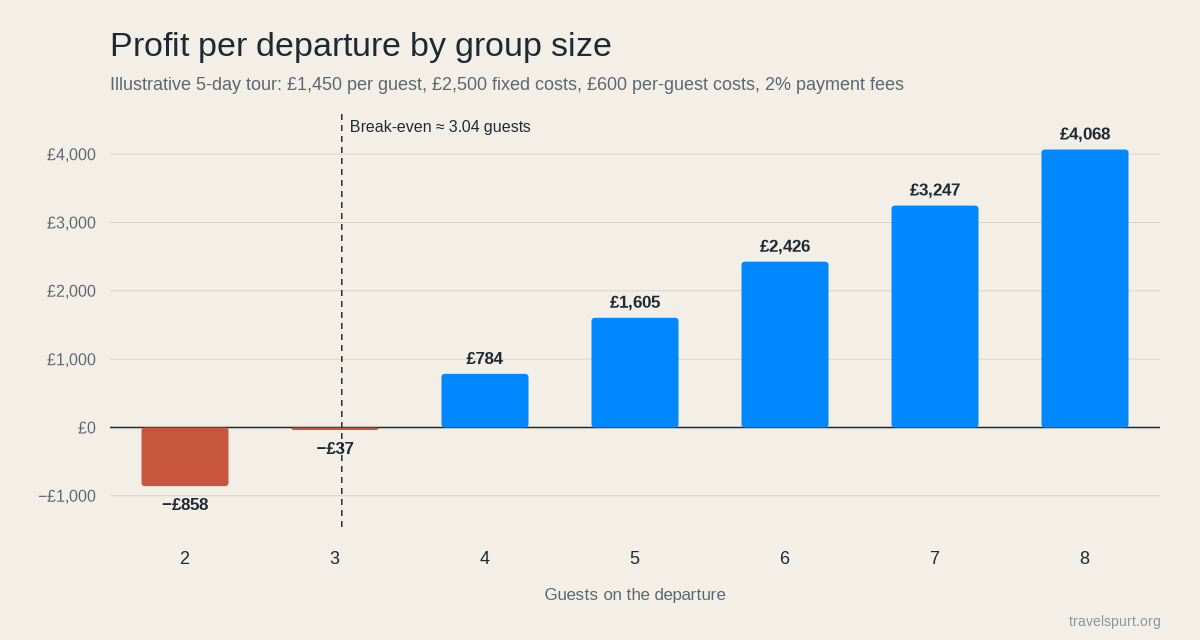
Knowing the break-even number for each tour helps you set a minimum group size in your terms and decide early whether to run, combine or reschedule a departure.
Step 5: Check the margin before you confirm
Profit is easiest to protect before the booking is confirmed, not after the tour. When a private group asks for a longer route, a premium hotel or an extra activity, re-run the numbers and adjust the price there and then. A five-minute check at quote stage is worth more than a careful review at the end of the season. For private enquiries, our guide to pricing a private multi-day tour lists every cost to include.
Common mistakes
- Forgetting payment fees. A small percentage on every payment adds up across a season.
- Using last year's supplier rates. Re-cost tours when rates change, not when the season ends.
- Leaving your own time out. If the profit only exists because your hours are free, the tour is not as healthy as it looks.
- Estimating mileage. Use the planned route, including detours and repositioning, to cost fuel.
How TravelSpurt shows profit per tour
In TravelSpurt, the profit report comes from the same booking as the itinerary and the invoice. Tour mileage is calculated from the route and feeds the fuel estimate, so you can see the margin on a booking before you confirm it, and every document updates if the booking changes. See pricing or book a demo to walk through one of your own tours.
Frequently asked questions
What is a good profit margin for a small tour operator?
It varies with the type of tour, your costs and your market, so there is no single right figure. What matters is knowing the margin on each departure, setting a minimum you are comfortable with, and pricing new tours to meet it.
How do I calculate the break-even point for a tour?
Add up the fixed costs of the departure, then divide them by what each guest contributes after their own costs and payment fees. Round up to get the minimum number of guests the tour needs to cover its costs.
Should I include my own time in tour costs?
Yes, if you want an honest picture. If a tour is only profitable because your own hours are unpaid, it is worth knowing that before you decide how many times to run it.
See how it works or pricing, or get in touch.