
How to price a private multi-day tour: every cost to include
By Zakhar Habib · 24 November 2026
To price a private multi-day tour, cost the whole trip for that one group (guide, vehicle, fuel, accommodation, entries, your own time and a share of overheads), then set the price so your target margin and payment fees are left over after every cost. Price the booking as a whole first and divide by the number of guests last, because almost everything on a private tour costs the same whether two people travel or six.
Why private tours need their own pricing method
On a scheduled group departure, fixed costs are shared across everyone who books a seat, so a per-person price makes sense from the start. A private tour is different. The client books the guide, the vehicle and the route for themselves, and those costs do not shrink if fewer people come. If you start from a per-person price taken from your group tours, a private couple can easily end up paying less than the trip costs you to run.
The safer habit is to build a quote for each private enquiry from its own route, dates and requests, then decide what each guest pays.
Every cost to include
Most underpriced private tours are missing a line, not using the wrong margin. Work through these groups for every quote.
Guide and driver
The day rate for each day of the tour, plus any travel days to reach the start or get home again. If your guide stays away from home, add their accommodation and meals for every night, not just the nights the guests are in a hotel.
Vehicle and fuel
Cost fuel from the planned route, including repositioning: the empty miles from your base to the pick-up and back again. A cost per mile for your vehicle makes this quick. Add a daily vehicle cost (hire, or a share of finance, servicing, tyres and insurance if you own it), plus parking, tolls and ferries.
Guest accommodation and inclusions
Rooms at the rate you will actually pay for the dates requested, not last season's rate. Then entries, tastings, activities, included meals and anything else promised in the itinerary. Private clients often ask for upgrades along the way, so cost each one as it comes in.
Your own time
Private tours take more planning per guest than group departures: back-and-forth with the client, bespoke routing, supplier bookings and changes. Put a value on those hours. If a tour only looks profitable because your planning time is free, it is worth knowing before you agree the price.
Selling costs and overheads
Card or payment platform fees, any agent commission, and a fair share of your insurance, marketing, website and software. An easy way to handle overheads is to work out a figure per tour day for the year and add it to every quote.
A worked example: three days for two guests
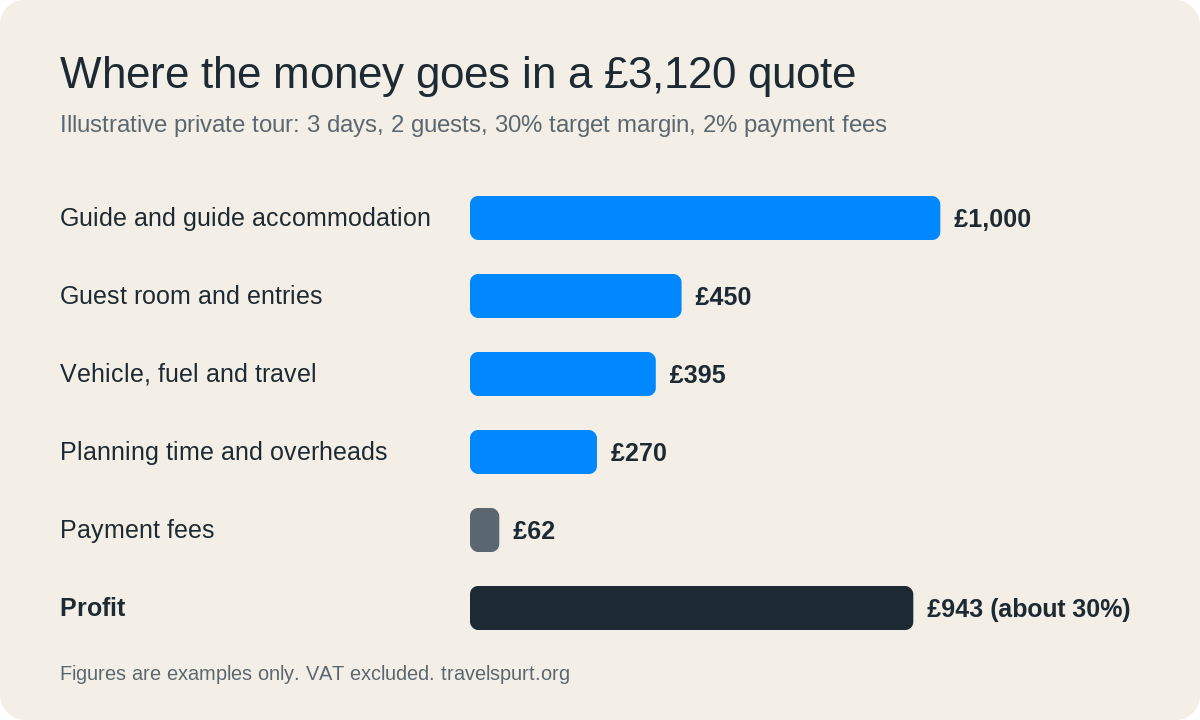
Here is an illustrative private three-day tour for a couple, two nights in one double room, with a driver-guide in your own vehicle. The figures are examples only; use your own rates. VAT is left out to keep the arithmetic clear.
| Cost | Amount |
|---|---|
| Driver-guide, 3 days at £260 | £780 |
| Driver-guide accommodation and meals, 2 nights at £110 | £220 |
| Fuel, 500 miles including repositioning at 25p a mile | £125 |
| Vehicle, 3 days at £70 | £210 |
| Parking, tolls and ferries | £60 |
| Guest room, 2 nights at £180 | £360 |
| Entries and tastings, 2 guests at £45 | £90 |
| Planning time, 4 hours at £30 | £120 |
| Overheads share, 3 days at £50 | £150 |
| Total cost | £2,115 |
Say you want a 30% margin and payment fees take about 2% of the price. Together that is 32% of the price, so the cost has to fit in the remaining 68%:
- Price = £2,115 ÷ 0.68 = £3,110.29, rounded up to £3,120
- Payment fees: 2% of £3,120 = £62.40
- Profit: £3,120 − £2,115 − £62.40 = £942.60, a margin of about 30%
- Per guest: £3,120 ÷ 2 = £1,560
Margin or markup: check which one you mean
Margin is profit as a share of the price. Markup is profit as a share of the cost. They are easy to mix up, and the difference matters. Adding 30% to the £2,115 cost gives £2,749.50. That looks like a 30% margin, but the profit of £634.50 is only about 23% of the price, before payment fees. Decide which one your target is, and divide by (1 − margin − fees) when you are working to a margin.
What changes when the group size changes
If the same tour is booked by four guests instead of two, the guide, vehicle, fuel, planning time and overheads stay the same. Only the per-guest lines move: an extra room and two more sets of entries. That is why a private tour for four can be priced lower per person than the same tour for two. It is also why it is safer to quote a total price for the party, with the number of guests stated, than a per-person price that could be applied to a smaller group.
When a client changes the route, adds a night or asks for a better hotel, re-cost the quote before you agree. The profit per tour guide shows how to check the margin on a booking and find its break-even point.
VAT and booking terms
How VAT applies to a tour depends on what you sell and how you buy it in. In the UK, many tour operators that buy in travel services and resell them fall under the Tour Operators' Margin Scheme (TOMS), which works differently from standard VAT. This is general information only, so check your own position with an accountant before you set prices. Make it clear in every quote whether the price includes VAT, and set out your deposit, balance and cancellation terms. Our guide to taking deposits and balances online covers the payment side.
Common mistakes
- Leaving out repositioning miles. The drive to the pick-up and home again costs fuel and guide time even with no guests aboard.
- Forgetting the guide's nights away. Their room and meals are a cost on every night of the tour.
- Quoting per person from a group tour price. Private tours carry the full fixed cost for one party.
- Using old supplier rates. Check hotel and entry prices for the actual dates before you send the quote.
- Not re-costing changes. An extra night or upgrade added by email can quietly remove most of the margin.
Where TravelSpurt fits
In TravelSpurt, each private booking holds its own pricing and estimated costs, which are internal and never shown to the traveller. On a desktop, the booking's Profitability panel shows gross revenue, guide cost, fuel (from the vehicle's fuel rate and the tour miles), VAT, net profit and margin. When a booking has no price yet, the Quote Calculator takes an accommodation estimate and a target margin and suggests a quote, the 30% deposit, a per-person price and the projected profit. The bookings guide explains each field, including how a client can accept a quote online.
Frequently asked questions
Should I price a private tour per person or per group?
Work out the price for the whole group first, because most private tour costs are fixed for the party. Then divide by the number of guests if the client wants a per-person figure, and state the group size the price is based on.
How much should a private tour cost compared with a group tour?
Usually more per person, because one party carries the full cost of the guide, vehicle and planning. How much more depends on the group size and your costs, so build each quote from the actual trip rather than adding a fixed percentage to a group price.
How do I turn a target margin into a price?
Divide the total cost by one minus your target margin and payment fee rate. For a 30% margin and 2% fees, divide the cost by 0.68, then round up.
See how it works or pricing, or get in touch.